
Cultural probes are qualitative research techniques that enable customers to document their own experiences and lives.
Documentation occurs as the experience unfolds. That is to the advantage that research isn't a set of afterthoughts gathered during an interview but rather an almost life-capturing of actions, context, behaviour, outcomes, and emotions.
Cultural probing, when done well, provides many more insights than interviews and can also be multidimensional.
You can execute cultural probing using a variety of techniques, such as:
All of these techniques can help users keep track of their own context, behaviour, thoughts and emotions.
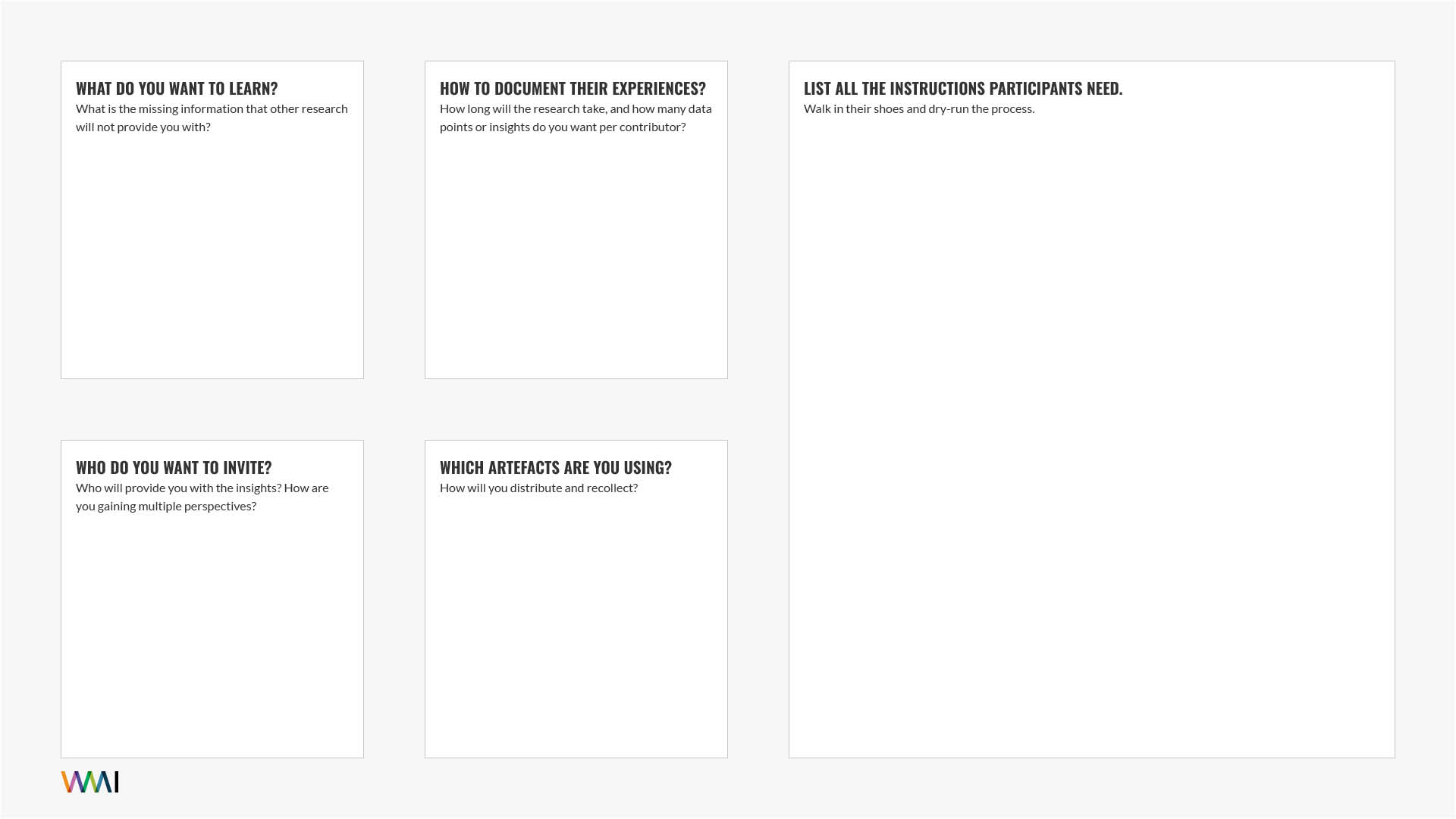
Preparation makes the difference, and that's no different for cultural probing.
So, before you start a cultural probe, you need to know:
Before anything else, when making an effort, you need to know why. Make clear what you want to learn and why cultural probing is the best research technique to do so.
You can't always capture a documented experience during an interview. When you want to understand the possibilities for improving the onboarding experience of elderly patients, it might make sense to ask them to create pictures of all the steps they are going through.
So what you want to learn in this case might sound like: "How can we enlighten the experience of older patients during the onboarding process."
The obvious case in the previous scenario would be older patients entering the hospital. However, administrators or nurses could also be asked to document the trajectory. If it does not reveal other facts, it at least gives you multiple perspectives.
So, evaluate beforehand who is going to provide you with the necessary insights to improve your product, service, or experience.
That is something to consider very well because it will make or break your research. Things you have to consider are:
Depending on what you want to learn and who you want to learn from, artefacts used in the research can vary.
To gain a deeper understanding of students' daily lives and design more effective on-campus experiences, consider asking them to keep a diary. Their experiences vary, and not all of them are easy to photograph.
If you want to gain a deeper understanding of the experience of an agent intervening during a car accident on a highway, recording a video can be very helpful in capturing the whole environment, the interactions of passing drivers and the problems in clearing the road.
© 2026 WAAI Design
