
Interviews uncover deep, personal insights by exploring people’s real experiences, goals, and challenges. They’re essential for designing innovations that truly meet user needs and fit their real-world context.
Whenever you want to develop an innovation or design a new product or service, you do this to help your customers accomplish their goals. In a more convenient matter than they used to do. Paramount to this is understanding your customer's context, obstacles and desires. That is where interviews enter the story. You want to learn from their previous experiences to gain a better understanding of what can be improved.
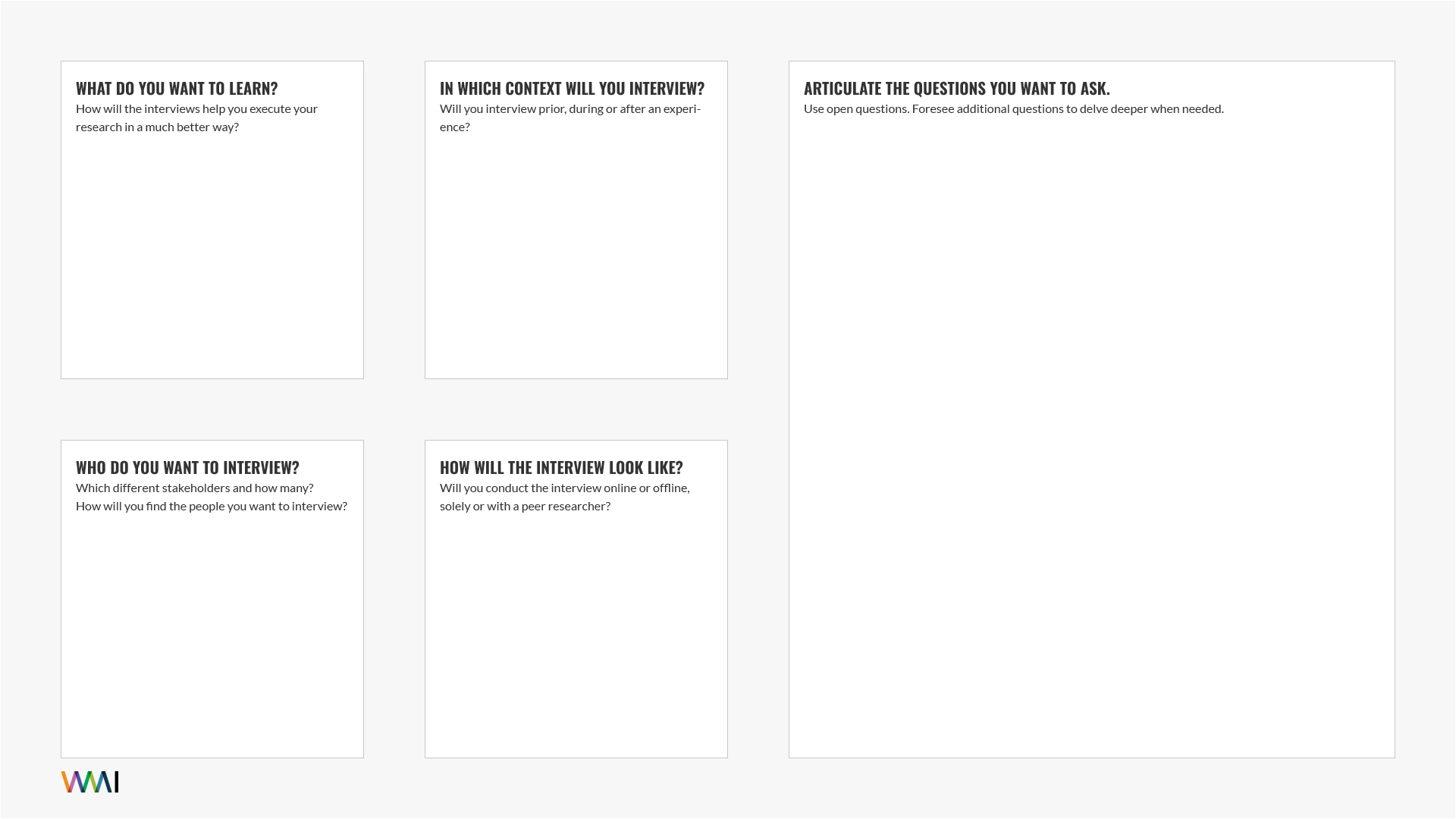
As in any act of research you conduct, you know what you want to learn. You prepare these interviews well to make sure you learn what you need to learn.
So, before you start an interview, you need to know:
Understanding what you want to learn begins by conducting thorough desk research. During that research, you map your unknowns. This desk research involves market research to learn about existing alternatives. However, prior to conducting interviews, you should inquire about past experiences, the desired outcome, and the context in which these experiences are lived.
Conducting thorough research will greatly benefit you by asking the right questions. Only asking the right questions will provide you with the wanted insights.
Having a significant impact on a large group of people is what everyone aspires to. However, only interviewing average users will give you a poor understanding of where that impact can be made. You do not want to ignore these average users, but most of you will learn from the extremes. Their experiences will show you where to improve what already exists.
You want to capture as many insights as possible. Therefore, you need to create a context or environment that is ideal for conducting the interview while also being perfect for bringing the interviewees at ease. Think carefully about the context you will create:
Be careful to always ask open questions. And be considerate about the questions you ask. Go in-depth and make sure people are invited to share their experiences rather than confirm your assumptions.
Ask also for what you have forgotten to ask. There might be things you didn't think about.
Knowing what you do not know you need to know is one of the most challenging aspects of customer research.
© 2026 WAAI Design
