
Journaling is a research method that captures people’s real-life experiences as they unfold over time. It offers rich, personal insights into daily routines, emotions, and contexts—ideal for designing with deeper empathy.
When you try to understand the people you are working for, you can use multiple ethnographic techniques. All of them offer you immersive insights from the people you want to understand, from a different perspective.
Journaling is, in this set of techniques, probably the most fulsome, as you give participants the freedom to document as deeply as they want, using a variety of forms.
A journal allows you to write pages each day, or just draw some quick pencil lines to express your feelings.
It is fulsome because it is not just a set of experiences summarised in one sentence, as is done in an interview. A journal allows participants to fully document what is happening as it happens, over a longer period of time (days to months, depending on the context).
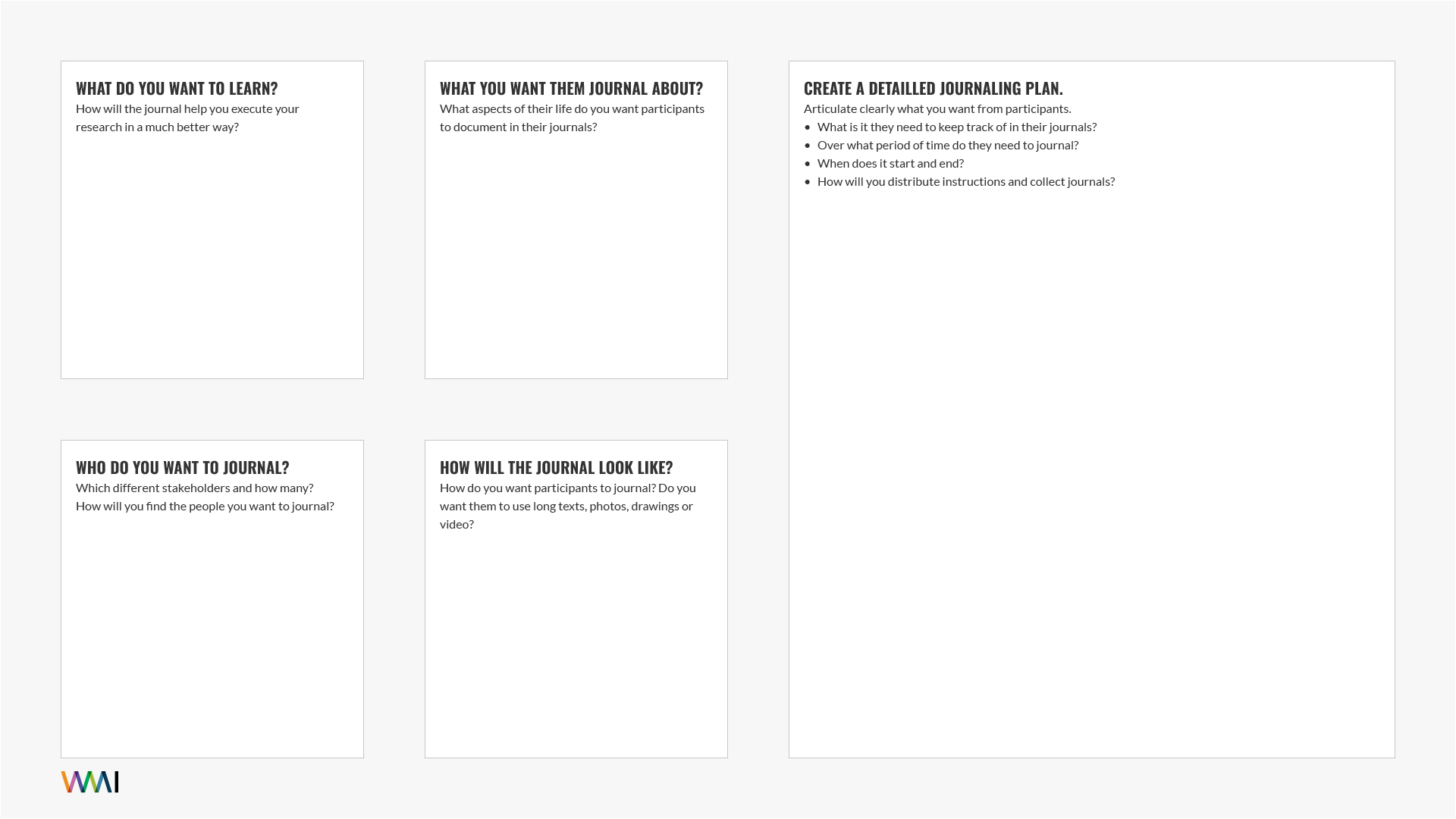
When you ask participants to journal, you want them to document (part of) their lives as they happen, daily and during a certain period. Depending on the topic your research is part of, you will be more interested in certain parts of their lives than others.
When you ask participants to keep track of their experiences in a journal, consider creating a template of questions. Not all that is happening in their lives will be suitable for your research. Try clarifying as much as possible what they need to document.
You also want to describe in what form or possible forms participants can document, and how much time they are expected to dedicate to the journal.
Journaling is a very open format of gaining understanding, and that is its strength, but to make sure you gain any understanding, it is important to set expectations.
Journaling is what you do when you have a broad idea of the problem you want to address, but you want to grow your understanding of the context of your audience. It is not a good fit to document the experience one has with a new banking app. However, when you want to better understand the context, habits and constraints of people suffering from diabetes, a journal is a good tool to learn from their morning routines, daily activities and eating habits.
Unlike other research techniques, such as interviews and surveys, journaling focuses on the direct beneficiaries of your development. It is their context you are trying to understand better. Asking other stakeholders is not relevant, they can provide you with a lot of insight in other domains, but understanding the context, you can only achieve with your audience or end customer.
© 2026 WAAI Design
